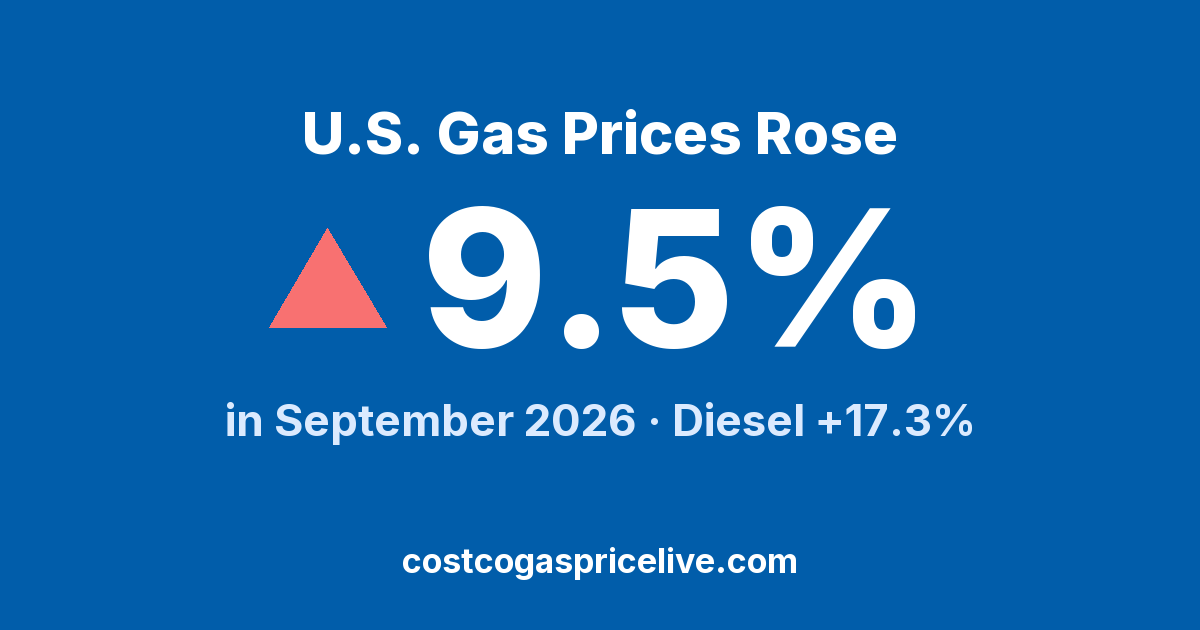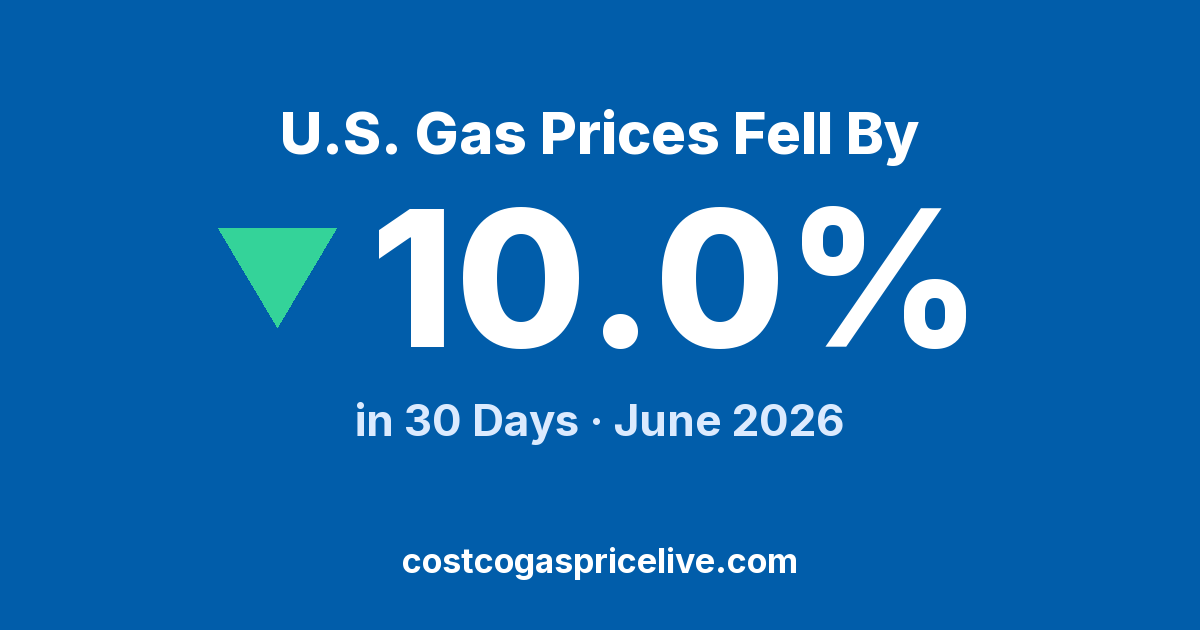
A month ago the story at the pump was a slide. This month it is a bottom. As of July 10, 2026, the average price of regular gasoline across the 570 U.S. Costco stations we track is $3.90 a gallon — down 22 cents, or 5.4%, from $4.12 a month ago, and diesel has fallen twice as fast, down 61 cents (−11.1%) to $4.92. But the fall ran out of road mid-window: regular slid to a $3.82 floor on July 8 — the cheapest since before the war — and has since bounced about 8 cents in two days, tracking AAA's broader average, which just reversed course and started rising as the U.S.–Iran ceasefire wobbled. It is the same turn we logged across Canada, the UK, and Australia this month — and it caps a remarkable round trip: a gallon of Costco regular has now given back the entire war spike, from a May peak near $4.60 to today's $3.90.
| Grade | June 11 | July 10 | 30-day change |
|---|---|---|---|
| Regular | $4.122 | $3.901 | ▼ $0.22 (5.4%) |
| Premium | $4.751 | $4.542 | ▼ $0.21 (4.4%) |
| Diesel | $5.530 | $4.919 | ▼ $0.61 (11.1%) |
National averages of posted prices at tracked U.S. Costco stations, $/gal. Snapshot taken July 10, 2026 — this article is not updated.
The slide bottomed on July 8 — then reversed
For three weeks the national average did nothing but fall, grinding from $4.12 on June 11 to a low of $3.82 on July 8, its cheapest reading since February. The engine was crude: after the June 18 U.S.–Iran memorandum to end the conflict and reopen the Strait of Hormuz, Brent fell below $70 a barrel by July 1 — roughly where it sat before the war began. Then the direction flipped. With the ceasefire looking fragile and crude climbing back into the $70s, AAA's national average jumped 5 cents overnight to $3.84 on July 9, and Costco's pumps followed within a day — the last two points on the chart below.
This month, the West gave it back
The regional story inverted. In June the Midwest led the country lower; in July it was the West Coast's turn to catch down. Washington's Costco average fell 51 cents a gallon and Oregon's 49 cents, with Arizona, Alaska, and Idaho each off more than 43 cents. Puyallup, Washington cut regular by 80 cents — the biggest station move in the country, tied with two Laguna-area warehouses in California — while the Midwest, having already unwound its spike, largely held: Indiana is still the cheapest state at $2.87, and Avon, Indiana, at $2.67, is the cheapest Costco pump in the nation.
| State | Stations | Avg now | 30-day change |
|---|---|---|---|
| Washington | 33 | $4.586 | ▼ $0.51 (10.0%) |
| Oregon | 13 | $4.222 | ▼ $0.49 (10.4%) |
| Arizona | 19 | $3.531 | ▼ $0.45 (11.2%) |
| Alaska | 3 | $4.309 | ▼ $0.44 (9.2%) |
| Idaho | 7 | $3.823 | ▼ $0.43 (10.1%) |
Biggest 30-day fallers by state-average price of regular at Costco, June 11 – July 10, 2026.
The cheapest and most expensive states right now
Geography still sets the spread. The gap between the cheapest and priciest state averages is $2.13 a gallon— Indiana's $2.87 against California's $5.00 — driven as always by state gas taxes, fuel blends, and regional refining. Notice that all five of the priciest states are in the West: exactly the group that fell hardest this month, and still the group with the most room left to fall.
Cheapest states (regular)
Most expensive states (regular)
| State | Costco avg |
|---|---|
| California | $5.000 |
| Hawaii | $4.759 |
| Washington | $4.586 |
| Alaska | $4.309 |
| Oregon | $4.222 |
State-average price of regular across tracked Costco stations, July 10, 2026. Puerto Rico is excluded — its pumps price in dollars per liter.
Why prices fell — and why they just turned
Everything at the pump this year traces back to one waterway. When the United States and Israel went to war with Iran at the end of February and Iran declared the Strait of Hormuz closed on March 4 — the channel for roughly a fifth of the world's oil — Brent rocketed from about $60 to more than $115 a barrel, and AAA's national average peaked at $4.56 on May 21, a four-year high. June 's relief, and most of July's, was that war premium draining away: the June 18 U.S.–Iran memorandum set the strait reopening, shut-in production eased from a May peak of 11.2 million barrels a day toward 8.3 million in June, and crude slid on hopes of peace until Brent dropped below $70 on July 1.
That is the deflation that pulled Costco regular from $4.12 to $3.82. The reason it stopped is that the ceasefire is only as solid as the strait is open. As the memorandum's durability came into question in early July, crude bounced back into the $70s and the pass-through reversed almost immediately — AAA's "reverse course" alertand the up-tick at the right edge of our chart are the same event. Costco feels these turns fast: warehouse clubs run the thinnest fuel margins in the business and reprice quickly, which is why its average round-trip — down 5.4% then up 8 cents in 48 hours — is sharper than the broader market's.
A caution before you extrapolate the chart
The last two points on the chart point up, not down — and which way the next thirty days break is, once again, a question about the Strait of Hormuz, not about summer driving. If the ceasefire holds and shipping keeps normalizing, the EIA still sees room to fall (see below). If it frays, the early-July bounce is a preview, not a blip. Pump prices follow crude with a one-to-two-week lag, so today's $3.90 already has some of the rebound baked in — and more may be coming.
How Costco compares with the AAA average
Nationally the two averages sit almost on top of each other — $3.90 across Costco's pumps versus AAA's $3.88 on July 10— but that near-tie is geography, not pricing. More than a quarter of Costco's U.S. stations sit in California and Washington, the country's most expensive fuel states, which drags its simple national average up. Put the comparison on equal footing, state by state, and the club discount is wide:
| State | AAA avg | Costco avg | Costco discount |
|---|---|---|---|
| Indiana | $3.210 | $2.868 | −34¢ |
| Oklahoma | $3.400 | $3.034 | −37¢ |
| Texas | $3.410 | $3.154 | −26¢ |
| Oregon | $4.530 | $4.222 | −31¢ |
| Washington | $4.990 | $4.586 | −40¢ |
| California | $5.380 | $5.000 | −38¢ |
AAA state averages versus Costco state averages from our tracker, both July 9–10, 2026. AAA covers every station statewide while Costco warehouses cluster in metro areas, so treat the gap as indicative.
Those gaps of 26 to 40 cents are wider than the 5-to-25-cent discount Costco typically holds. When wholesale is falling and most stations are slow to pass it through, the club gap stretches — and it has stayed stretched all summer.
Will gas prices fall again?
The official forecasts still point gently down — provided the strait stays open. The EIA's July outlook has retail gasoline averaging $3.80 a gallon in the third quarter and $3.90 for 2026 as a whole, falling to $3.64 in 2027 as Brent eases toward $65, on the assumption that Hormuz shipping keeps recovering toward pre-war volumes by early 2027. The near-term risk is all to the upside and all political: the same report warns that renewed disruption would reverse the relief quickly, which is precisely what the first days of July hinted at.
California remains its own weather system. The state lost roughly 17% of its refining capacity in under a year — Phillips 66's Los Angeles refinery and Valero's Benicia plant both closed — and UC Davis economists estimatethe closures will eventually add about $1.21 a gallon versus the old equilibrium. Even after a 31-cent Costco drop since our June report, California's $5.00 Costco average is the highest of any state we track, and AAA's all-station California figure is $5.38. If you fill up there, the club discount matters more than ever.
Costco pump prices are a snapshot observed July 10, 2026 and will differ at the pump today. This site is independent and not affiliated with Costco Wholesale Corporation.