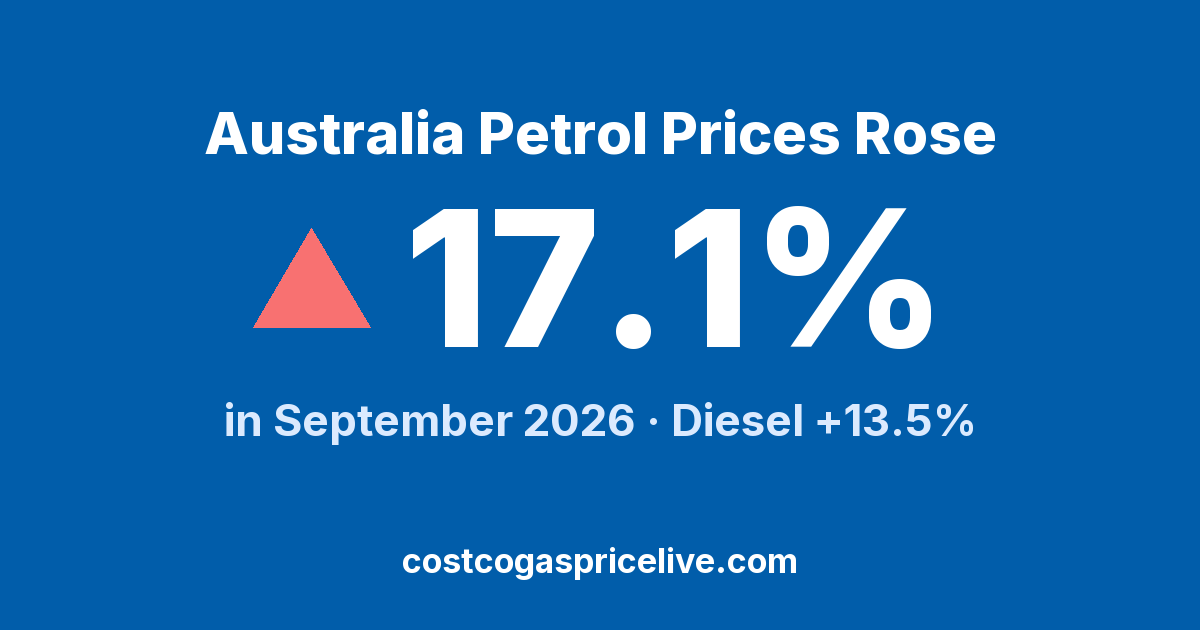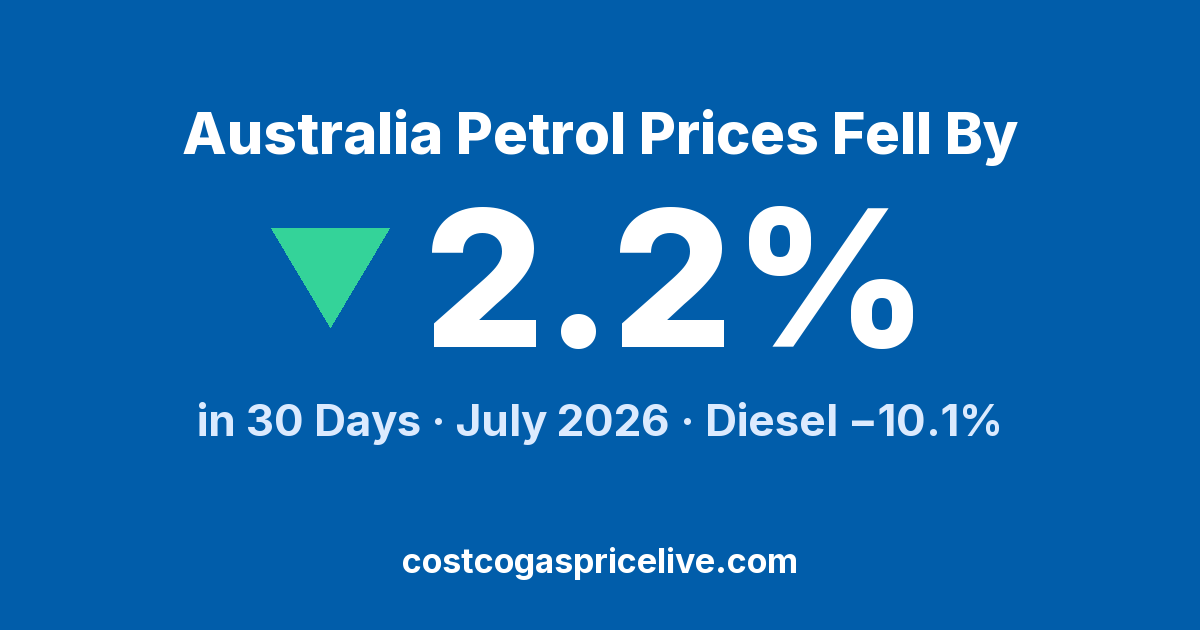
The global fuel-price retreat has reached Australia, and it is not subtle. As of June 10, 2026, the average price of Unleaded 91 across the 14 Costco fuel stations we track is $1.584 a litre — down 12.6¢, or 7.4%, from $1.710 a month ago. Diesel has fallen harder than anywhere else we cover: down 31¢, or 13.9%, to $1.936 — a bigger one-month drop than at our U.S., Canada, or UK warehouses. Every tracked station is cheaper than it was in mid-May, on every grade. One caveat belongs up front: these prices lean on a temporary 32¢-a-litre fuel-tax holiday — and it expires on June 30.
| Grade | May 12 | June 10 | 30-day change |
|---|---|---|---|
| Unleaded 91 | $1.710 | $1.584 | ▼ 12.6¢ (7.4%) |
| E10 | $1.690 | $1.573 | ▼ 11.7¢ (6.9%) |
| Premium 98 | $1.908 | $1.788 | ▼ 12.0¢ (6.3%) |
| Diesel | $2.248 | $1.936 | ▼ 31.2¢ (13.9%) |
National averages of posted prices at tracked Costco fuel stations in Australia, AUD/L. Costco stations carry either Unleaded 91 or E10 depending on the site. Snapshot taken June 10, 2026 — this article is not updated.
A cycle bump on the way down — then three weeks of falls
The unleaded line tells a very Australian story. It eased to $1.684 by May 15, then jumped about 6¢ in days to peak at $1.747 on May 22 — the familiar shape of a capital-city price cycle cresting — before the global slide took over: from May 26 the average fell more than 15¢ in a straight line to $1.584, its low for the window. Diesel, which has no retail cycle, simply fell from day one — including a 7¢ single-day drop on May 30, its steepest of the month.
Three states fell 14¢ in lockstep
Costco prices its Australian fuel in tight bands, and the slide shows it: New South Wales, Victoria, and Western Australia each cut their state average by exactly 14¢ a litre, and five stations across three states now share the national-low price of $1.547 — Marsden Park, Auburn, and Crossroads in Sydney, plus Adelaide and Perth Airport. Canberra, at $1.687, is the priciest Costco fuel in the country; the full network spread is just 14¢.
| State | Stations | Avg now | 30-day change |
|---|---|---|---|
| New South Walesbiggest faller: Marsden Park | 4 | $1.552 | ▼ 14.0¢ (8.3%) |
| Victoriabiggest faller: Moorabbin | 3 | $1.587 | ▼ 14.0¢ (8.1%) |
| Western Australiabiggest faller: Perth Airport | 2 | $1.547 | ▼ 14.0¢ (8.3%) |
| Queensland | 3 | $1.600 | ▼ 8.7¢ (5.2%) |
Biggest 30-day fallers by state-average price of Unleaded 91 at Costco, May 12 – June 10, 2026. South Australia and the ACT have a single station each, so they are ranked below but not compared here.
Every state, ranked by today's Costco average
| State / territory | Stations | Costco avg (Unleaded 91) |
|---|---|---|
| South Australia | 1 | $1.547 |
| Western Australia | 2 | $1.547 |
| New South Wales | 4 | $1.552 |
| Victoria | 3 | $1.587 |
| Queensland | 3 | $1.600 |
| ACT | 1 | $1.687 |
State-average price of Unleaded 91 (or E10 where carried) across tracked Costco stations, June 10, 2026, cheapest first. See every station on the live Australia map.
Why prices are falling — and the asterisk on every number
Australia's autumn at the bowser was historic. After the United States and Israel went to war with Iran at the end of February and the Strait of Hormuz closed, capital-city petrol peaked near $2.58 a litre in Sydney on March 30 — obliterating the previous nominal record of $2.15 from April 2024 — and diesel went well past $3. Two forces have unwound most of that spike. The first is the market: crude has retreated as Israel and Iran halted attacks, with Brent averaging $107 in May, its first monthly decline since December, helped by OPEC+'s fourth straight monthly quota increase and slumping Chinese imports. Petrol's Singapore benchmark fell about 12¢ a litre over the month, and the wholesale terminal gate price followed — down 19¢ for petrol and 34¢ for diesel — even with a weaker Aussie dollar clawing some of it back.
The second force is the tax office. From April 1 Canberra halved fuel excise from 52.6¢ to 26.3¢ a litre, and the states agreed to forgo the GST on top — roughly 32¢ a litre of total relief, a $2.55-billion package. That is the asterisk on every number in this report: the ACCC notes capital-city petrol is now just 2.4¢ above its pre-war level — but only with the tax cut in place. Strip it out and underlying petrol is still roughly 26¢ dearer than a year ago, and diesel about 33¢ above pre-war even before the tax returns.
Diesel's outsized 31¢ fall is the war premium deflating. Diesel spiked hardest on the way up — Australia imports more than 90% of its fuel, much of it from Asian refineries that run on Hormuz crude — and the April 15 fire at Viva's Geelong refinery, which cut one of the country's two refineries to partial output, tightened things further. With repairs due to finish during June, the ceasefire holding crude down, and wholesale diesel collapsing, the scarcity premium has drained out at almost 1¢ a day.
And the famous petrol price cycle? The war suppressed it — the ACCC says typical cycle movements in Sydney, Melbourne, Brisbane, and Adelaide "largely have not occurred" through March, April, and May — but it is creeping back: RACQ flagged south-east Queensland sites spiking to 219.9¢ in early May, and the bump to $1.747 in our chart in the week of May 22 has the same fingerprints. As of June 10 the ACCC's buying tips list prices falling in all four eastern cycle cities — they kept falling right through the King's Birthday long weekend, which almost never happens.
A caution before you extrapolate the chart
The de-escalation driving this slide cracked on the day of this snapshot. On June 9–10, Iran shot down a U.S. Apache helicopter near the strait, the U.S. struck back, and Iranian missiles targeted U.S. bases in Bahrain, Jordan, and Kuwait; crude whipsawed between the high-$80s and low-$90s. Australian bowsers run a week or two behind the wholesale market, so none of that is in these prices yet — and the NRMA notes diesel's Singapore benchmark already turned up in early June, which may stall diesel's slide.
How Costco compares with the servo down the road
Independent tracking puts the gap plainly: FuelRadar's live brand table has Costco's network average at 158.2¢ against a 174.6¢ market average — 16.4¢ a litre cheaper — and during April's spike the discount stretched to almost 26¢, the same widen-in-a-crisis pattern we found in the U.S., Canada, and the UK. City by city against June 10 capital averages:
| City | City avg | Costco | Difference |
|---|---|---|---|
| Perth | 171.3¢ | 154.7¢ (Perth Airport) | −16.6¢ |
| Melbourne | 169.2¢ | 158.7¢ (Moorabbin) | −10.5¢ |
| Sydney | 165.1¢ | 154.7¢ (Auburn) | −10.4¢ |
| Brisbane | 170.3¢ | 162.7¢ (North Lakes) | −7.6¢ |
| Canberra | 175.7¢ | 168.7¢ (Canberra) | −7.0¢ |
| Adelaide | 159.7¢ | 154.7¢ (Adelaide) | −5.0¢ |
PetrolPulse capital-city averages for regular unleaded versus the posted Costco price at a station in each city, both June 10, 2026. Costco fuel is members-only.
Will prices keep falling? Watch July 1
The market signals point down for now: the ACCC's cycle tips say buy-side conditions in the eastern capitals, wholesale petrol kept falling into June, and the NRMA expects "continued price falls at the bowser over the next week". Further out, the forecasts split on the strait: Rystad warns a reopening could flip the market "from fear of shortage to fear of surplus" very quickly, and the World Bank sees Brent averaging $86 this year and $70 in 2027 — while the June 9–10 re-escalation is the standing reminder that the premium can come back overnight.
But the date that matters most to Australian drivers is July 1. The 32¢ tax holiday expires at midnight on June 30, and the Transport Minister says people "should at this stage expect that it's coming off" . Treasury-based estimates put Sydney petrol near $1.99 a litre in July and diesel around $2.37 if the cut lapses — an overnight jump of roughly 32¢ landing just as school holidays begin. The government says it will make a final call in the lead-up to July 1. If you are reading this in late June: fill up before the changeover.
Costco pump prices are a snapshot observed June 10, 2026 and will differ at the pump today. This site is independent and not affiliated with Costco Wholesale Corporation.